Perspectives to incubate & scale hyperscaler based business groups at IT consulting/ services firms

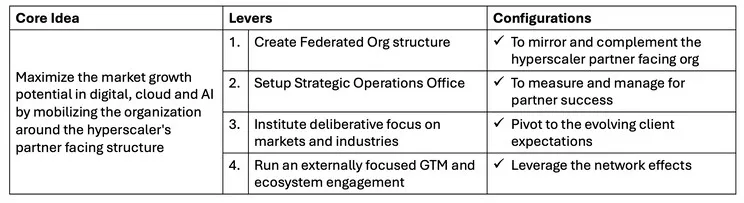
Every industry in the enterprise world is undergoing digital transformation. What was once seen as an initiative for cost arbitrage is now rightfully viewed as a lever for business transformation, enabling new revenue streams, acquiring new customer segments, and realizing exponential business value. Cloud and associated platforms form the backbone of enterprise digital transformation. Consequently, major consulting and IT firms, which primarily facilitate these transformations, have pivoted their organizational structures to enable services and offerings around the hyperscaler ecosystem to better serve enterprises. While each consulting and IT firm adopts various strategies and structures for offering solutions within the hyperscaler ecosystem, there are a few structural configurations that, from my perspective, can offer significant advantages for incubating and scaling hyperscaler ecosystem offerings to their client base. Although there is no single correct approach to organizing structures around a hyperscaler ecosystem, incorporating the following elements, as described in this article, can provide a significant competitive advantage by aligning resources and measures to realize synergies from hyperscaler partnerships.
Core idea
Federated org structure - build layers complementary to the hyperscaler’s partner facing organisation
Perhaps the most sticky point between the hyperscaler and consulting firms is about the org structure and how they face up to each other. The hyperscalers are in fundamentally different business as compared to the consulting firms - one focused on product and the other on services. Different product offerings of the hyperscalers are addressed through different business units within the consulting firms. For example, the commodity cloud & IAAS products of the hyperscalers could be serviced through the cloud and infrastructure unit within the consulting firms and are sold to IT organizations of enterprises. Where as the AI capable PAAS and SAAS product offerings of hyperscalers are usually serviced through digital and transformation focused units within the consulting firms and are usually sold direct to businesses or CXOs within enterprises. Hence the consulting firms are justifiably content to be organized the way they are, but often are at the cross-roads with the hyperscalers because of the ambiguities in such structure and having to interface with multiple executive sponsors within the partner organization.
Is it really important for hyperscalers and their partners to be aligned in a coherent way? Not really. There are plenty of successful partners out there who figured out with the hyperscalers on effective ways to interface with other. However with cloud, digital, and AI being at the forefront of most enterprises for transformation and capex investments, it is beneficial for the consulting firms and hyperscalers to be structurally aligned in a way which creates an amplifying effect and positive reinforcement cycle.
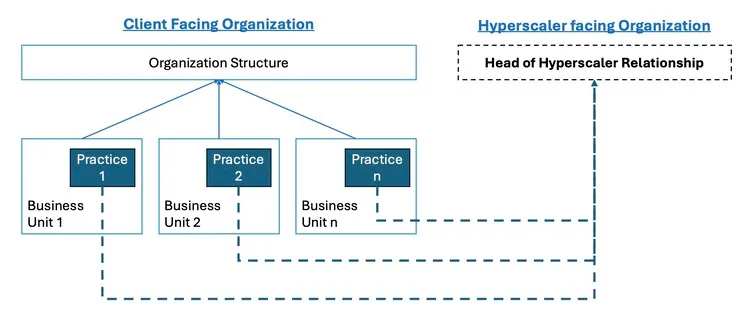
One of the pragmatic ways to achieve this is for consulting firms to adopt a “federated org structure” consistent with the hyperscaler’s partner facing organization. How does it work? It is about keeping the different packets of hyperscaler facing capabilities with different business units, and allowing them to make their own plans and business decisions, but creating a virtual orchestration layer cutting across these business units, harmonizing them under hyperscaler focused leadership, and providing them with unifying, non-invasive, and strategic direction as a wrapper over the current structure. This is accompanied with a “head of relationship” who assumes the role of executive sponsor for the relationship providing strategic overlay, driving consensus, and unifying the operations pertaining to the hyperscalers. The structure is federated in the sense that the autonomy of each hyperscaler facing units are not compromised - they still make their own decisions according to their own ground realities, and execute their own business. But they become a part of on overall orchestration layer that sets unifying vision, and harmonizes operations across the business units in a consistent and coherent manner.
Strategic operations office - measure and manage for partner success metrics
What you measure is what you manage. Hyperscalers typically measure success by measuring the consumption and utilization of its platform resources by enterprises. Consumption of platform resources are driven by enterprise’s spend on IT and digital programs aimed at transforming its business and IT landscapes. And these transformations are often facilitated by IT and consulting firms. A business change initiative at an enterprise is typically a leading indicator of increased platform consumption from a hyperscaler.
Hence, there should be a natural interlock between how a hyperscaler measures its success, and how an IT and consulting firm tracks its growth and market success, right? In reality, this is not often as straight forward as it seems.
The metrics for success that are essential to track the growth of hyperscalers are not necessarily the primary KPIs typically tracked by IT consulting firms from their inception. Therefore, it becomes crucial for IT service firms to align their measurement frameworks with those of hyperscalers. This alignment is not often a proactive instinct of IT services and consulting firms, as its benefits are not immediately obvious in organizations that are heavily focused inwardly and on their client relationships. Hence, this alignment is only enabled by strong leadership, with a clear intent, strategy and objectives in mind. One way of achieving this alignment is by instituting a dedicated office that orchestrates and manages the strategic operations catered for hyperscaler-focused metrics at the IT consulting firms.
Such alignment can be achieved by focusing on two key areas: competency enablement, and incentives and partner success.
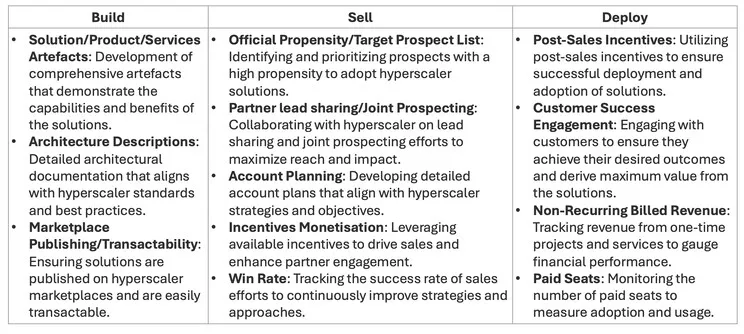
Partner Success Metrics:
From the perspective of the hyperscaler, the IT consulting firm’s journey of facilitating solution follows a certain lifecycle, broadly classified as Build, Sell and Deploy. By identifying and measuring metrics and KPIs across this lifecycle, the IT consulting firm can manage the hyperscaler focused business group comprehensively, and with increased synergies of growth with the hyperscaler.
Competency enablement:
This involves implementing comprehensive training programs and certification paths to build talent and capacity in hyperscaler-specific skillsets, often leveraging hyperscaler-generated content and artefacts. Such organized programs lead to two-fold benefits. First, they help organically build and scale skills within the organization, ensuring long-term sustainable success. Second, by objectively measuring the skilled talent pool, they position the IT consulting firm favorably with both hyperscalers and client enterprises, often leading to increased wallet share from enterprises.
Deliberative focus on markets and industries
Amidst intense competition, hyperscalers are in constant pursuit of levers to improve their competitive advantage. What was once a general-purpose technology platform is now being reframed to cater specifically to the context of various markets and industries, addressing ever-increasing client expectations. IT consulting firms, which facilitate and amplify the consumption of hyperscaler platform resources at enterprises, must pivot to this reality. They should develop offerings focused on specific markets and industry segments, incorporating the culture, ethos, and regulatory complexities of these industries into their solutions.
Key Strategies for Market and Industry Focus
-
Market Segmentation:
- Identify Key Markets: Conduct market research to pinpoint key markets where hyperscaler solutions can add significant value. Analyze factors such as market size, growth potential, and the current adoption rate of digital technologies.
- Segment by Industry: Tailor solutions to address specific industry challenges, such as data security in healthcare or customer experience in retail.
-
Industry Expertise:
- Develop Industry Knowledge: Invest in training and hire professionals with relevant experience to build deep industry expertise.
- Create Industry-Focused Teams: Establish dedicated teams for each target industry to provide insights and develop tailored strategies.
-
Customized Solutions:
- Tailor Solutions: Develop customized solutions that cater to the unique needs of each industry.
- Showcase Success Stories: Use case studies to demonstrate successful implementations and build trust with potential clients.
-
Strategic Partnerships:
- Collaborate with Leaders: Form partnerships with industry leaders and associations to stay updated on trends and innovations.
- Engage with Hyperscalers: Co-develop solutions with hyperscalers to enhance offerings and align with technological advancements.
-
Market-Specific GTM Strategies:
- Develop GTM Strategies: Create go-to-market strategies tailored to each market and industry, identifying effective channels and crafting resonant messaging.
- Monitor and Adapt: Continuously monitor and adapt GTM strategies based on market feedback and changing dynamics.
By focusing deliberately on markets and industries, IT consulting firms can enhance their relevance and effectiveness in delivering hyperscaler solutions, driving business growth and establishing themselves as trusted advisors in their clients’ digital transformation journeys.
Run an externally focused GTM and ecosystem engagement
The hyperscaler economy is fueled by network effects. The economy thrives on not just the platforms and solutions developed by the hyperscalers, but on the solutions offered by partners, and market or industry focused partnerships offering targeted solutions on their respective segments. Hence an externally focused GTM strategy offers a multiplier effect as compared to an inwardly capabilities focused view. This external focus will only come as a result of focused leadership with strategic intentions, and clear objectives.
There are 3 cornerstones to such external focus on GTM.
-
Collaborative Ecosystem Engagement:
- Partner Ecosystem: Actively engage with the partner ecosystem, including hyperscalers, other technology partners, advisory firms, and industry associations. This collaboration can lead to co-innovation and the development of integrated solutions that provide greater value to customers.
- Joint Go-To-Market Initiatives: Work with hyperscalers and other partners on joint go-to-market initiatives. This can include co-branded marketing campaigns, joint webinars, and collaborative sales efforts.
- Ecosystem Events: Participate in and host ecosystem events such as industry conferences, trade shows, and partner summits. These events not only provide opportunities to showcase the firm’s expertise, and stay updated on industry trends, but also help capture the mindshare of the industry.
-
Strategic Alliances and Partnerships:
- Form Strategic Alliances: Establish strategic alliances with key players in the industry to enhance the firm’s offerings and market reach. These alliances can provide access to new technologies, markets, and customer bases.
- Leverage Hyperscaler Programs: Take advantage of hyperscaler partner programs that offer resources, incentives, and support for joint go-to-market activities. These programs offer an alternate revenue stream for the consulting firms, and also help to fund partially for the selling effort.
-
Customer Success and Feedback:
- Customer Success Programs: Implement customer success programs to ensure that clients achieve their desired outcomes with the firm’s solutions. This involves regular check-ins, support, and training to maximize the value derived from the solutions.
- Feedback Loops: Establish feedback loops to gather input from customers and partners. Use this feedback for its original intent, that is, to continuously improve offerings and address any issues promptly.
The significant opportunity for IT consulting firms through enterprise digital transformation necessitates that IT consulting firms strategically align their structures, operations, and market approaches with hyperscaler ecosystems. By adopting a federated organizational structure, establishing a strategic operations office, focusing deliberately on markets and industries, and running an externally focused go-to-market strategy, these firms can unlock significant synergies and drive exponential growth. Embracing these strategies enhances their competitive edge and positions them as strategic partners in their clients’ digital journeys, ultimately leading to sustained success in the hyperscaler-driven economy.
"Perspectives to incubate & scale hyperscaler based business groups at IT consulting/ services firms" by Vinoth Haldorai is licensed under CC BY 4.0. You are free to share and adapt this material with attribution.
Comments