AI "everywhere-by-design" - an effective operating model for AI-powered digital transformations
The advent of generative AI has sparked significant buzz in the industry, and has revitalized the conversations around the applicability and leverage of AI in enterprises. Business leaders and executives are grappling with the choices between comprehending the true impact of AI and the perceived sense of urgency to capitalize on the capabilities of AI in their businesses.
And increasingly a number of them are conceptualizing and piloting sandboxed experiments to identify specific AI use cases that can solve a particular problem or create a new opportunity. While this approach can help to generate some quick wins and proofs of concept, it is not sufficient to achieve a holistic and sustainable AI-powered digital transformation for a number of reasons. They often encounter challenges such as lack of clear vision, strategy, and governance, siloed and fragmented data and systems, and low adoption and scalability of AI solutions in their enterprises. AI use cases are often isolated and disconnected from the broader business context and objectives. They do not consider how AI can be integrated, aligned, and scaled with the existing or desired digital capabilities of the enterprise. Moreover AI use cases are often driven by technology rather than business needs and outcomes. They focus more on the technical feasibility and novelty of AI rather than the business value and impact of AI, relying on a small group of experts and researchers to design and implement AI rather than empowering and enabling the business users and stakeholders to adopt and scale AI.
How to think about AI “everywhere-by-design”
Possibly, a better approach for business leaders and executives to leverage AI could be to think about how to embed AI on top of each of the digital capabilities they want to build or extend, rather than identifying specific AI use cases to implement in isolation. This calls for holistically infusing AI as a capability within every digital initiative, and weaving it into the foundational operating model with the view of further improving OKRs that those initiatives aim to impact. This ensures that AI is aligned and integrated with the business strategy, vision, and objectives. It considers how AI can enhance and enable the digital capabilities that are critical for the enterprise to achieve its goals and outcomes. It creates a clear and coherent roadmap and governance for AI implementation and adoption across the enterprise. This also ensures that AI is driven by business value and impact rather than technology feasibility and novelty.
A roadmap for AI “everywhere-by-design”
To illustrate how AI “everywhere-by-design” can work in action, let us consider a fictional retail bank. The banks is spending capital on a enterprise wide digital transformation program with an objective to improve its overall customer experience, in order to compete with new-age digital banks, and to acquire and retain more customers.
AI “everywhere-by-design” roadmap
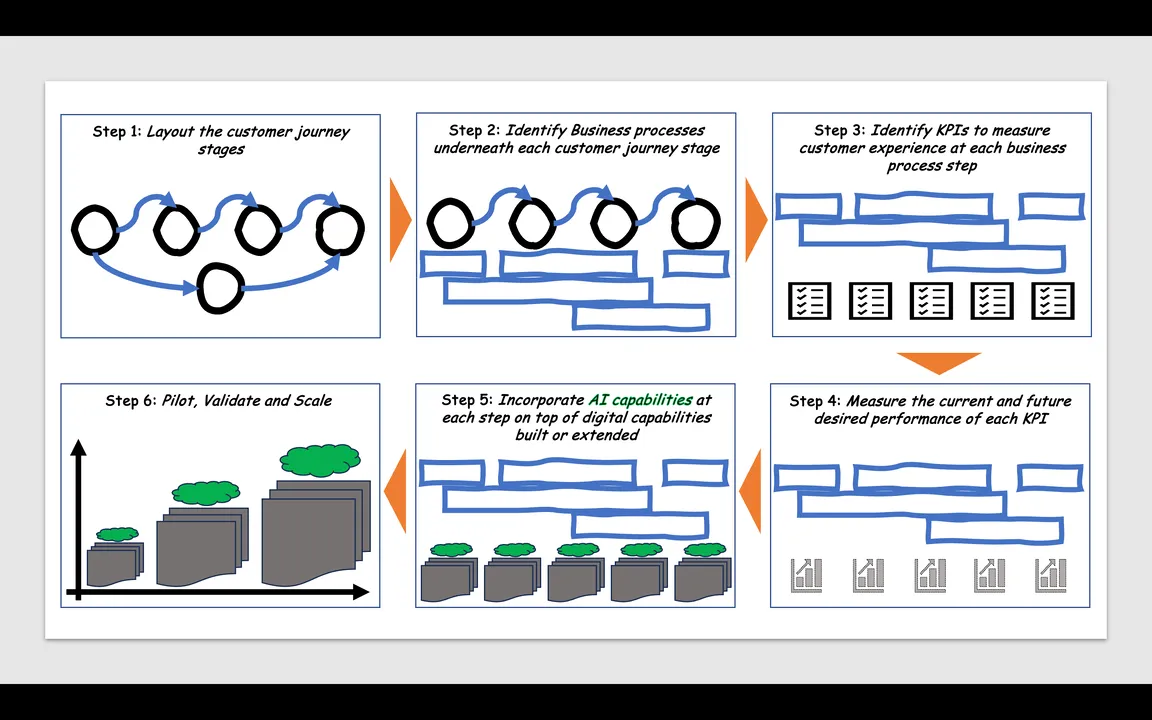
- Step 1: Lay out the business value chain, and identify the various customer journeys within the value chain
The first step is to map out the business value chain of the bank, and identify the various customer journeys within it by capturing the sequence of activities that the bank performs to create and deliver value to its customers and the end-to-end experiences that the customers have with the bank, from the moment they become aware of the bank’s offerings, to the moment they become loyal and advocate for the bank. For the purpose of illustration, lets consider a simplistic customer journey stages such as “Awareness” to “Consideration” to “Decision” to “Activation” to “Retention” and to “Loyalty”.
- Step 2: Identify the business process underneath each customer journey stage
The next step is to identify the business processes that underpin each customer journey stage, and the key stakeholders involved in them. The key stakeholders are customers, employees, partners, regulators, etc. The business processes involved could include Marketing and branding, Customer acquisition, Customer onboarding, Customer Activation, and Customer Retention.
- Step 3: Identify KPIs and Metrics to measure the customer experience at each of the business process steps
Next is to identify the key performance indicators (KPIs) and metrics that can measure the customer experience at each business process step, and the data sources that can provide them. The identified KPIs and Metrics to improve could be represeted as follows
- under Marketing and branding could be Share of Voice, Net Promoter Score, Customer Lifetime Value
- under Customer Acquisition could be Cost per Lead, Customer Acquisition Cost, Conversion Rate, Return on Investment
- Under Customer Onboarding could be Churn Rate, Revenue Attribution, Customer Effort Score
- under Customer Activation could be Average Revenue Per User, Customer Engagement Score, Customer Satisfaction Score, Customer Retention Rate
- Under Customer Retention could be Customer Loyalty Index, Customer Lifetime Value, Customer Advocacy Score, Customer Support Response Time;
- and under Loyalty could be Customer Lifetime Value, Net Promoter Score, Share of Voice, Brand Awareness Metrics.
Businesses need to target the most meaningful KPIs across the stages in order to meaningfully track and measure the customer experiences interacting with them.
- Step 4: Measure the current performance and future desired performance for each of the identified KPIs and Metrics
The current performance and future desired performance for each of the identified KPIs and Metrics can be measured using various data sources, such as customer surveys, web analytics, social media analytics, CRM systems, etc. For example, the current Share of Voice for the bank can be calculated by dividing the number of mentions of the bank on social media by the total number of mentions of all the competitors in the same market. The future desired Share of Voice can be set based on the bank’s strategic goals and market position.
- Step 5: Incorporate AI capabilities at each of the business process steps, to meet or exceed the performance measure of the identified KPIs and metrics
AI capabilities can be incorporated at each of the business process steps, to enhance the customer experience and optimize the operational efficiency. For example, under Marketing and branding, AI can be used to create personalized and relevant content for each customer segment, based on their preferences, behaviour, and feedback. AI can also be used to monitor and analyze the sentiment and tone of the customers on social media, and respond accordingly. Under Customer Acquisition, AI can be used to generate and qualify leads, using predictive analytics and natural language processing. AI can also be used to recommend the best products and services for each customer, based on their needs and profile. Under Customer Onboarding, AI can be used to automate and streamline the verification and KYC processes, using biometric and facial recognition. AI can also be used to provide a seamless and intuitive user interface, using chatbots and voice assistants. Under Customer Activation, AI can be used to increase the usage and engagement of the customers, using gamification and loyalty programs. AI can also be used to provide personalized and timely offers and incentives, based on the customer’s behaviour and life events. Under Customer Retention, AI can be used to predict and prevent customer churn, using machine learning and anomaly detection. AI can also be used to provide proactive and empathetic customer support, using natural language understanding and sentiment analysis. Under Loyalty, AI can be used to create and nurture customer advocates, using social proof and referral programs. AI can also be used to measure and improve the customer lifetime value, using customer segmentation and retention analysis.
- Step 6: Pilot, Validate and Scale
The final step is to pilot, validate and scale the AI solutions, using agile and iterative methods. The pilot phase involves testing the AI solutions on a small scale, with a selected group of customers and employees, and collecting feedback and data. The validation phase involves evaluating the AI solutions on their effectiveness, efficiency, and ethics, and making adjustments and improvements as needed. The scale phase involves deploying the AI solutions on a large scale, across the entire organization and customer base, and monitoring and maintaining their performance and quality.
As illustrated, this is a holistic approach to embed AI capabilities across the entire business value chain, and align them with the organization’s goals and objectives. This way the infusion of AI is strategic and integral part of the digital transformation journey, that can scale and permeate across the organization in a sustainable and scalable manner.
Conclusion
AI and gen AI are not just technologies, but capabilities that can transform businesses and processes. However, to realize their full potential, organizations need to adopt an holistic operating model for enterprise AI transformation, such as the above specified AI ’everywhere-by-design“ model. As described this model involves embedding AI and gen AI on top of the digital processes to be built or extended, rather than treating them as separate or isolated projects. This way, organizations can achieve higher value, faster speed, and lower waste from their AI investments. AI “everywhere-by-design” is not a quick fix, but a long-term journey that requires commitment, collaboration, and creativity. However, the rewards are worth the effort, and can help organizations gain a sustainable competitive advantage in the digital age.
References
- McKinsey & Company, “The state of AI in 2023: Generative AI’s breakout year” (August 1, 2023).
- McKinsey & Company, “A winning operating model for digital strategy” (January 23, 2019).
"AI "everywhere-by-design" - an effective operating model for AI-powered digital transformations" by Vinoth Haldorai is licensed under CC BY 4.0. You are free to share and adapt this material with attribution.
Comments